
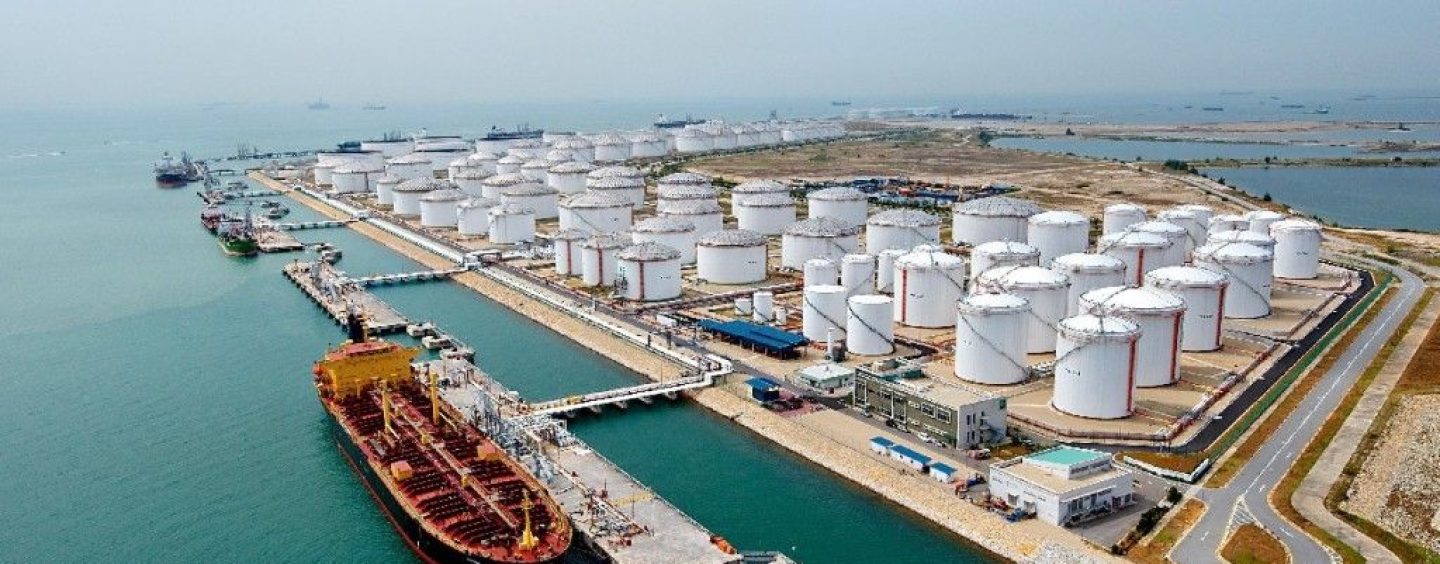
Georgian Refinery in Kulevi Intends to Give Up Using Russian Oil – General Director
The oil refinery in the port of Kulevi intends to completely abandon importing Russian oil and switch to feedstock from Turkmenistan and Kazakhstan, the general director of the Georgian company Black Sea Petroleum (BSP, owner of the refinery) David Potskhveria said.
“The strategic goal of Georgia’s first oil refinery is to replace Russian feedstock. The company began its operations by refining Russian oil, but at this stage is actively working to diversify feedstock, which will ultimately allow it to export products to the European Union market,” Potskhveria was quoted as saying by the publication bm.ge.
“To this end, we are working with Turkmen oil, and at a later stage with Kazakh and other alternative sources,” he said.
The EU market is currently closed to products manufactured using Russian oil, and alternative feedstock will remove this restriction, Potskhveria said.
In addition, Potskhveria said that the company has encountered difficulties in importing oil from Turkmenistan by rail through Azerbaijan. “Unfortunately, and somewhat unexpectedly, organizing rail transit in our direction through Azerbaijani territory has become difficult. We reached an agreement on Turkmen oil several months ago, but its transportation is being delayed,” he said. “We hope this problem will be resolved in the near future, and this will allow the company to activate an alternative supply chain. Once this railway network [in Azerbaijan] is operational, transit of other sources, including Kazakh oil, will automatically follow,” he said.
Potskhveria previously said that the refinery imports Russian oil for processing in compliance with current sanctions restrictions and based on recommendations from British and Swiss law firms. “In the event of a sanctions violation, neither the tax service nor SOCAR [the State Oil Company of the Azerbaijani Republic], through whose Kulevi oil terminal oil is supplied to the BSP refinery, will allow a vessel or product under sanctions to enter Georgian customs territory,” he said.
It was previously reported that the European Union planned to include the oil terminal in Kulevi in the next sanctions package against Russia in February, but Georgian authorities insisted that neither the terminal nor the refinery built nearby violate the sanctions regime.
On March 10, Georgian authorities circulated a letter from the EU Special Envoy for Sanctions, David O’Sullivan, addressed to Georgian Foreign Minister Maka Bochorishvili, stating that the terminal would not be included in the sanctions list. Georgia’s commitment not to circumvent EU sanctions through Georgian territory will continue to be closely monitored, and if necessary, the EU is ready to take appropriate measures to ensure that its sanctions are not undermined, O’Sullivan said.
Georgia’s only oil refinery, which is being built in the Khobi municipality, launched its first phase with a capacity of 1.2 million tonnes at the end of last year. The commissioning of the second phase will increase the plant’s capacity to 4.5 million tonnes of oil per year. The total investment is estimated at $700 million.
The SOCAR-owned terminal in the port of Kulevi (located on the eastern coastal part of the Black Sea near the village of Kulevi in Khobi municipality) was commissioned in May 2008, with a total capacity of 10 million tonnes of oil cargo per year.
According to the Georgian National Statistics Service, the country sharply increased exports of petroleum products in January-February, which were virtually absent in the same period last year. Georgia exported 219,100 tonnes of petroleum products worth $93.2 million in January-February 2026, with supplies going to 12 countries. In December last year, exports of petroleum products amounted to $32 million, and in November they stood at $30 million.
The main buyers of Georgian petroleum products in January-February were Turkey (32,000 tonnes worth $24.3 million), Togo (32,000 tonnes worth $19 million), Malta (31,200 tonnes worth $16.5 million), Singapore (37,900 tonnes worth $11.8 million) and the UAE (34,800 tonnes worth $11.8 million). Supplies were also sent to Cyprus, Uzbekistan, Armenia, Ukraine, Kazakhstan, Azerbaijan and China.