The Zangezur Corridor: A Geopolitical Turning Point in the South Caucasus and a New Strategic Axis for Eurasia
By Yujel Karauz, Turkish Military Attaché to Azerbaijan (during 2011/13)
The South Caucasus has historically been one of the world’s most strategically contested regions. Situated between Europe and Asia and connecting the Black Sea, the Caspian Basin, Russia, Türkiye, Iran, and the Middle East, it has long attracted the attention of regional and global powers. Today, the region has once again moved to the center of Eurasian geopolitics, largely because of the growing importance of the Zangezur Corridor.
Often described as a transportation route linking mainland Azerbaijan with the Nakhchivan Autonomous Republic through southern Armenia, the corridor represents much more than a road or railway. It could reshape regional trade, energy security, political alignments, and Eurasian connectivity. If implemented, it would create a direct land connection between Türkiye and Azerbaijan and extend eastward across the Caspian Sea toward Central Asia. It would also strengthen the Middle Corridor connecting Europe with Central Asia and China through Türkiye, the South Caucasus, and the Caspian region.
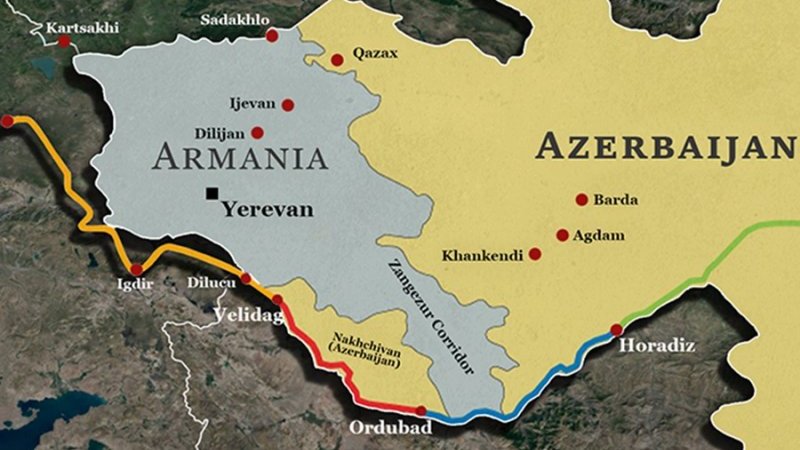
The roots of the issue go back to the Soviet period. Administrative decisions placed Zangezur within the Armenian Soviet Socialist Republic, geographically separating Nakhchivan from mainland Azerbaijan. Soviet internal borders became internationally recognized frontiers following the dissolution of the Soviet Union in 1991. The First Karabakh War subsequently severed direct transportation links between Azerbaijan and Nakhchivan, forcing Baku to depend primarily on routes through Iran and Türkiye.
A new phase began after the Second Karabakh War in 2020. The trilateral declaration signed by Azerbaijan, Armenia, and Russia on 10 November 2020 called for the reopening of regional economic and transportation links. Although the document did not clearly establish an extraterritorial corridor, it created a political framework for restoring connections between western Azerbaijan and Nakhchivan. Since then, different interpretations of the declaration have transformed the issue into one of Eurasia’s most debated geopolitical questions.
Türkiye is among the corridor’s strongest supporters and regards it as an important component of its long-term regional strategy. Ankara argues that greater connectivity can promote economic integration, regional stability, and cooperation while strengthening the strategic partnership between Türkiye and Azerbaijan. A direct connection through Nakhchivan would also provide Türkiye with easier access to Azerbaijan and, through the Caspian Sea, to the Turkic republics of Central Asia.
From Türkiye’s perspective, the route is a missing link in the Middle Corridor. Its completion could reduce transportation times between Europe and Asia, diversify international supply chains, expand energy transit options, and reinforce Türkiye’s position as a major logistics and commercial hub. It would complement the Baku–Tbilisi–Kars railway, Caspian port facilities, and transportation networks extending toward Kazakhstan, Uzbekistan, Turkmenistan, and China.
For Azerbaijan, restoring direct transportation with Nakhchivan is both a practical necessity and a central element of the post-2020 regional order. President Ilham Aliyev has consistently emphasized that improved connectivity could benefit the entire South Caucasus by facilitating trade, investment, and economic development. Baku therefore presents the corridor not simply as a national project but as an opportunity to transform the region from a zone of conflict into a network of cooperation.
However, disagreements over the corridor’s legal and security status remain unresolved. Azerbaijan seeks an efficient and uninterrupted connection with Nakhchivan, while Armenia rejects any arrangement that could limit its sovereignty. The fundamental dispute is not over reopening transportation routes in principle, but over how border controls, customs procedures, security arrangements, and legal jurisdiction would operate.
For Armenia, the debate touches directly on sovereignty, territorial integrity, national security, and domestic politics. Prime Minister Nikol Pashinyan supports reopening regional transport links through his government’s “Crossroads of Peace” initiative. This proposal envisions Armenia as a transit hub connecting Türkiye, Azerbaijan, Iran, Georgia, and wider Eurasian markets. Yet Yerevan insists that every road and railway crossing Armenian territory must remain under Armenian sovereignty, customs authority, border control, and legal jurisdiction.
Armenia’s concerns are shaped by fears that the term “corridor” may imply an extraterritorial route outside Armenian control. Armenian officials therefore prefer the language of transportation links rather than a special corridor. A sustainable settlement must distinguish between unhindered transit and extraterritorial sovereignty. Transit could be simplified through agreed customs procedures, technological monitoring, and international guarantees without eliminating Armenia’s authority over its territory.
Reopening transportation links could nevertheless provide Armenia with important economic benefits. The country has remained partly isolated because its borders with Türkiye and Azerbaijan have been closed for decades. New routes could reduce transportation costs, expand access to regional markets, attract foreign investment, and improve Armenia’s integration into Eurasian supply chains. Domestic political divisions, security concerns, and opposition from certain diaspora groups, however, continue to complicate the debate.
Iran has expressed the strongest regional reservations. Tehran repeatedly declares that internationally recognized borders in the South Caucasus must remain unchanged. Armenia provides Iran with an important land connection to the Caucasus and, indirectly, to Georgia, the Black Sea, and European markets. Iranian leaders fear that an arrangement weakening Armenian control near the Iranian border could restrict Iran’s strategic access and alter the regional balance.
Iran is also concerned about the strengthening partnership between Türkiye and Azerbaijan and the emergence of a more integrated Turkic geopolitical space. Expanded east–west transportation networks could reduce Azerbaijan’s dependence on Iranian territory for access to Nakhchivan and diminish Iran’s role as a transit country. Tehran has therefore reinforced its relationship with Armenia while promoting alternative routes, particularly the International North–South Transport Corridor connecting Russia, Iran, the Caspian region, and India.
Nevertheless, the Zangezur Corridor does not necessarily have to become a strategic loss for Iran. If implemented through sovereign and inclusive arrangements, new transportation networks could connect with Iranian routes and create complementary north–south and east–west trade opportunities. Much will depend on whether the project is presented as an exclusive geopolitical axis or as part of a broader regional connectivity system.
Russia occupies a more complicated position. As the traditional security power in the South Caucasus, Moscow has sought to preserve its influence through military presence, mediation, economic relations, and involvement in regional transportation networks. Russia supported reopening transport links under the 2020 declaration and initially expected Russian border forces to play an important supervisory role. However, the war in Ukraine has reduced Moscow’s ability to dominate political developments in the region.
Russia still favors renewed transportation links but does not want to be excluded from their political or security architecture. A route operating independently of Moscow could weaken Russian leverage, while prolonged regional tension could also damage its interests. Russia must therefore balance its relations with Azerbaijan, Armenia, Türkiye, and Iran while responding to growing Western involvement.
The United States and the European Union generally regard regional connectivity as a means of supporting economic development, reducing conflict, and diversifying transportation and energy routes between Europe and Asia. Western actors have encouraged Armenia–Azerbaijan negotiations and supported efforts to achieve a comprehensive peace agreement. At the same time, they emphasize that any transportation arrangement must respect international law, mutual consent, sovereignty, and territorial integrity.
For Europe, the corridor’s importance has increased as governments and businesses seek alternatives to routes passing through Russia. The Middle Corridor has acquired greater strategic value because it connects Asian markets with Europe through Central Asia, the Caspian Sea, Azerbaijan, Georgia, and Türkiye. The Zangezur route could supplement this network by providing another connection through Nakhchivan and southern Armenia. Its commercial success, however, would depend on modern infrastructure, harmonized customs rules, efficient Caspian ports, competitive tariffs, and predictable political conditions.
The corridor also has significant implications for the Organization of Turkic States. Improved physical connectivity could strengthen trade, tourism, investment, educational exchanges, energy cooperation, and digital integration among Türkiye, Azerbaijan, Kazakhstan, Kyrgyzstan, Uzbekistan, and other participating states. In this context, the route symbolizes a broader strategic objective: creating stronger economic and institutional links across the Turkic world without necessarily turning them into a military or confrontational bloc.
Its energy dimension is equally important. The South Caucasus already hosts pipelines carrying Caspian oil and natural gas toward Türkiye and Europe. Although the corridor would initially serve road and rail transportation, improved connectivity could support future electricity transmission lines, fiber-optic networks, and related energy infrastructure. Such projects would contribute to Europe’s efforts to diversify suppliers and increase the strategic importance of Azerbaijan and Central Asia.
Yet infrastructure alone cannot guarantee peace. If the project is imposed through pressure or interpreted as a challenge to Armenian sovereignty, it could deepen tensions involving Armenia, Azerbaijan, Iran, Russia, and Türkiye. If developed through negotiation, reciprocal access, and transparent legal mechanisms, it could instead become a confidence-building project. The essential requirements include an Armenia–Azerbaijan peace agreement, clear border delimitation, reciprocal recognition of territorial integrity, mutually accepted customs procedures, and credible security guarantees.
Practical compromises remain possible. Armenia could retain full sovereignty while providing Azerbaijan with simplified and reliable transit to Nakhchivan. In return, Armenia could gain access to Azerbaijani and Turkish transportation networks. Digital customs systems, sealed cargo procedures, advance electronic declarations, and neutral monitoring could reduce security concerns without creating an extraterritorial zone.
Ultimately, the Zangezur Corridor is a test of whether the South Caucasus can move beyond historical conflict toward cooperation, commerce, and regional integration. Its importance extends far beyond the connection between mainland Azerbaijan and Nakhchivan. It concerns Türkiye’s access to Central Asia, Armenia’s economic opening, Azerbaijan’s regional position, Iran’s strategic interests, Russia’s changing influence, and Western attempts to diversify Eurasian trade routes.
If developed through dialogue, respect for sovereignty, and reciprocal economic benefit, the corridor could become an important component of the emerging Eurasian transportation architecture. It could strengthen the Middle Corridor, connect regional markets, improve energy security, and contribute to a more stable South Caucasus. If political rivalry outweighs compromise, however, it may remain an unrealized opportunity and another source of tension.
The choices made by regional leaders will therefore shape not only the future of the South Caucasus but also the wider balance of power and connectivity across Eurasia. The Zangezur Corridor is more than a transportation initiative: it is a geopolitical crossroads whose outcome may define the next phase of relations between Europe, the Caucasus, Central Asia, and the wider Turkic world.