Strategic Transformation of Russia Along the South Caucasus Axis and Its Implications for the Turkic World
By Yucel Karauz
Introduction and Strategic Framework Mainstream Western strategic analyses arguing that Russia is “weakening, declining, or hurtling toward inevitable collapse” are incomplete and fail to align with ground realities. Moscow continues to project global and regional influence far beyond its objective economic size, driven by its nuclear arsenal, energy leverage, defense manufacturing capacity, diplomatic flexibility, engagement in non-Western platforms like BRICS and the SCO, and its asymmetric partnership with Beijing.
However, this does not mean Russia is immune to structural crises. The long-term costs of a wartime economy, constraints on access to technology and finance, permanent alienation from the Western world, and a deepening dependency trap vis-à-vis China have reduced Moscow from a global “superpower” to a “constrained major power” whose operational space is shrinking, yet retains a fierce capacity for intervention. This structural transformation is most acutely felt, and geopolitical fault lines most intensely fractured, in the South Caucasus and the Turkic world.
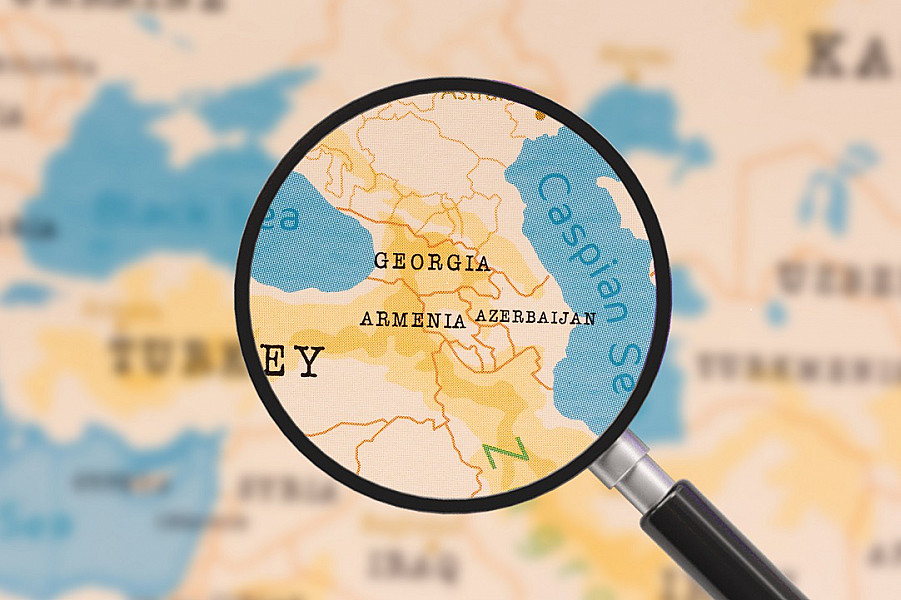
1. Russia in the South Caucasus: Declining Hegemony and Power Vacuum Historically, the South Caucasus has served as one of the most sensitive security buffer zones of Russia’s “near abroad” doctrine. Yet, the current geopolitical conjuncture is profoundly shaking the traditional Moscow-centric hierarchy in the region:
The End of Absolute Dominance: Russia remains an actor that must be reckoned with through its military bases, security commitments, and instruments for managing frozen conflicts; however, it has largely lost its status as the region’s sole arbiter.
The Rise of China and Other Actors: Moscow’s redirection of focus and resources toward the Western front due to the war in Ukraine has paved the way for China to expand its economic and logistical footprint in the South Caucasus and the Caspian basin. Concurrently, Turkey’s growing weight and the diplomatic overtures of the EU and the US have transformed the regional equation into a multi-actor theater of competition.
Transformation of the Security Architecture: Russia’s image as a “reliable protector and security provider” across the former Soviet space has eroded. As Moscow’s capacity to manage crises diminishes, regional countries have increasingly gravitated toward diversifying their security architectures and forging localized alliance networks.
2. Implications for the Turkic World and Strategic Roadmap Russia’s loss of influence and declining geopolitical capacity in the South Caucasus open a historic window for the geopolitical integration of the Turkic world. This power vacuum and transformation generate the following strategic outcomes for the Turkic world and Turkey:
Unlocking Geopolitical Integration: The South Caucasus functions as the geographic bridge connecting the Turkic world. The weakening of Russia’s monopolistic control mechanisms facilitates the deepening of the Azerbaijan-Turkey axis of integration, the materialization of the Organization of Turkic States (OTS) vision, and the emergence of an alternative center of gravity preventing regional states from being squeezed between the West and Russia.
The Middle Corridor and the Zangezur Connection: Transport corridors that bypass or balance Russia serve as the lifeblood of the economic and logistical independence of the Turkic world. The Zangezur connection and the trans-Caspian Middle Corridor are not merely trade routes; they are strategic security projects anchoring the Turkic geography at the heart of global supply chains.
Military and Defense Industry Integration: Cooperation in military training, logistics, command-and-control, and joint exercises must be deepened across the Turkic world, led by Turkey and Azerbaijan. Shaped by the spirit of the Shusha Declaration, this model forms the cornerstone of deterrence against external interventions.
Multi-Dimensional Balancing Diplomacy: Turkic states must factor in Russia’s remaining hard-power reaction capacity and regional sensitivities. Therefore, the strategy must not be to directly provoke Moscow, but rather to proactively fill emerging power vacuums in alignment with national interests through proactive diplomacy, economic integration, and legal frameworks.
3. Concrete Measures Required for Turkey and the Turkic World
1. Strategic Early Warning and Intelligence Integration: A continuous early warning mechanism must be established to monitor military movements, proxy activities, and shifts in the balance of power along the Black Sea, Caucasus, and Central Asia axes in real time.
2. Joint Production in the Defense Industry: Air defense systems, electronic warfare, UAV/UHA technologies, and joint ammunition production projects should be scaled up across the OTS geography.
3. Critical Infrastructure Security: The Zangezur and Middle Corridor projects must be treated as strategic security infrastructures against sabotage, cyber threats, and geopolitical disruptions, ensuring the physical and digital safety of these transit lines.
4. Diversification of Dependencies: The principle of avoiding dependence on a single center for energy supply and critical raw materials must be strictly implemented, accompanied by an expansion of trans-Caspian alternative routes, LNG capacity, and renewable energy integration.
Conclusion
Russia may be declining along the South Caucasus axis; however, this does not imply that Moscow will completely withdraw from the region or abandon its reflex to exercise hard power. Moscow retains the capacity to generate crises, diplomatic gridlock, and geopolitical manipulation.
The correct strategic path for Turkey and the Turkic world is to pursue a proactive, coordinated geopolitical mindset that does not underestimate Russia, avoids falling into escalation traps, but resolutely fills the vacuums left by Moscow’s receding influence through the institutional integration of the Turkic world, the security of the Middle Corridor, and collective defense capabilities.