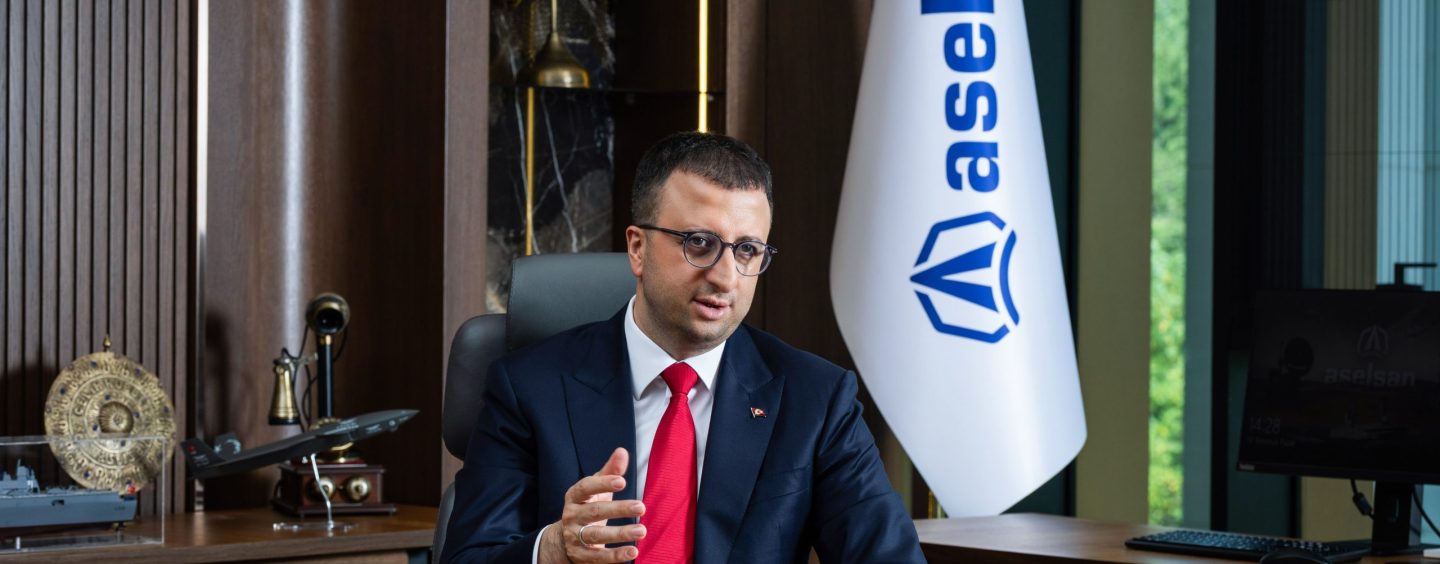
Exclusive Interview with Mr. Ahmet Akyol, General Manager of ASELSAN for Azerbaijan Today magazine.
Questions prepared by Rovshan Pashazadeh
A.T.: ASELSAN currently exports defense industry products to 97 countries worldwide. In your view, what are the main factors behind the growing global interest in and demand for Türkiye’s defense industry products?
Ahmet Akyol: I believe the growing international interest in Türkiye’s defense industry comes from a combination of technological capability, operational experience and the ability to respond quickly to changing security needs. Today’s customers are not only looking for advanced systems; they also want reliable delivery, flexibility, long-term support and solutions that can be adapted to their own requirements. Türkiye has built a strong defense ecosystem that can meet these expectations across many different domains.
ASELSAN is a strong example of this transformation. Today, our systems are exported to 97 countries, and we have 27 affiliates in 25 countries. We have developed broad capabilities across air defense, radar, electronic warfare, electro-optics, precision-guided munitions, naval systems, secure communications and autonomous technologies. More importantly, we are increasingly bringing these capabilities together as integrated solutions. Our multi-layered, domestically produced integrated air defense architecture Steel Dome and its counter drone layer DRONEDEF are good examples of this approach, combining sensors, command-and-control, electronic warfare solutions and different effectors within a single architecture.
Another important factor is that we do not see international cooperation simply as selling a product. We want to build long-term partnerships through local production, co-development, co-production and technology transfer. This approach is strengthening our relationships across Europe and NATO countries, the Middle East, Africa and Asia-Pacific. The growing interest is also visible in the number of international delegations visiting ASELSAN: The growing international interest in ASELSAN is also reflected in the increasing number and level of delegations we host. Since the beginning of 2026, we have welcomed 175 delegations from 64 countries. More importantly, these visits have included high-level delegations led by figures such as NATO Secretary General Mark Rutte, the President of Poland and the Chief of the General Staff of Jordan. This growing engagement demonstrates not only increasing interest in our technologies, but also ASELSAN’s expanding role as a long-term technology and strategic partner.
Our recent growth shows that this approach is delivering results. Our backlog reached USD 23.2 billion in the first half of 2026, while ASELSAN rose to 40th place in the Defense News Top 100, the highest position ever achieved by a Turkish defense company. For us, these achievements show that ASELSAN is increasingly recognized not only as a supplier from Türkiye, but as a global technology company and a long-term partner for countries looking to strengthen their own defense capabilities.
A.T.: Modern conflicts have highlighted the growing challenge posed by unmanned aerial vehicles and other low-altitude threats. What technological priorities is ASELSAN focusing on to adapt its air defense architecture to this rapidly evolving threat landscape?
Ahmet Akyol: Modern conflicts have clearly shown that the threat environment is changing very rapidly. We are now facing not only traditional aircraft and missiles, but also low-cost UAVs, FPV drones, swarm attacks and increasingly sophisticated electronic threats. At the same time, modern warfare requires greater precision, longer range and much faster decision-making. We closely follow these developments on the battlefield and continuously adapt our technology roadmap and product portfolio accordingly.
One of our main priorities is therefore to strengthen our capabilities against drones and other low-altitude threats. This is where solutions such as DRONEDEF, which forms an important counter-UAV layer of our broader Steel Dome architecture, become increasingly important. We are developing different solutions for different types of threats, combining electronic warfare, jamming, high-power microwave, laser, interceptor drones and kinetic systems. The objective is to provide an effective response while also considering the cost of engagement, particularly against low-cost and mass-produced threats.
But the lessons of modern warfare go beyond air defense. We are also strengthening our precision-strike capabilities through solutions such as TOLUN, GÖZDE and LGK, while continuing to invest in advanced radar, electronic warfare, electro-optics, autonomous systems and AI-supported technologies. In the autonomous domain, systems such as TUFAN Kamikaze Unmanned Surface Vehicle and KILIÇ Kamikaze Autonomous Underwater Vehicle reflect our growing focus on intelligent, autonomous and mission-adaptive capabilities across different operational domains. We increasingly see these capabilities as interconnected: detecting a threat earlier, processing information faster and engaging it with the most appropriate solution.
Another major priority is moving these technologies into serial production at the scale and speed required by today’s demand. We have been preparing for this growth for many years. Our Oğulbey Technology Base is a major part of this strategy and will significantly expand our air defense production capacity. At the same time, we continue to invest in new production and testing infrastructure, including additional facilities for air defense, smart munitions and guidance technologies. We are also increasing automation across our production lines and strengthening our supplier ecosystem.
A.T.: Can the “Steel Dome” be considered a new milestone in Türkiye’s air defense architecture? How does it integrate radar, sensor, electronic warfare and weapon systems, and enable real-time data processing and coordinated decision-making?
Ahmet Akyol: Yes, I believe Steel Dome represents an important milestone in Türkiye’s air defense architecture because it brings different capabilities together as one integrated system rather than treating them as separate solutions. It provides layered protection against a wide spectrum of threats, from low-cost drones and aircraft to cruise missiles and other long-range threats.
At the core of Steel Dome is a system-of-systems approach. Advanced radars and electro-optical sensors provide detection, tracking and identification across different ranges and altitudes. Electronic warfare capabilities add a non-kinetic layer by detecting and disrupting hostile systems, while short-, medium- and long-range air defense systems provide the kinetic response. By bringing these capabilities together, Steel Dome creates a layered architecture in which the most appropriate sensor and effector can be used according to the type of threat.
An important part of this architecture is DRONEDEF, the counter-UAV layer of Steel Dome. It addresses the rapidly growing threat from mini and micro UAVs, FPV drones and swarm attacks. Rather than relying on a single solution, DRONEDEF combines detection and tracking, electronic jamming, high-power microwave, laser and kinetic capabilities within an integrated architecture. This is particularly important from a cost-to-kill perspective, as it allows us to respond to different drone threats with the most appropriate and cost-effective solution.
The key is how we connect all these elements. Our command-and-control architecture fuses data from multiple sensors to create a common air picture in real time. AI supports threat assessment, target prioritization and the selection of the appropriate response, while critical decisions remain under human control. Secure communications connect sensors, command centers and effectors, enabling the entire architecture to operate in a coordinated manner.
This integration gives commanders a coordinated response across all layers of air defense, rather than a collection of standalone systems. It is also designed as an evolving architecture: as threats change, new sensors, electronic warfare capabilities and effectors can be integrated. This allows Steel Dome to continuously adapt, detect threats earlier and respond faster.
A.T.: ASELSAN has substantially increased its investment in research, development and production capacity. How do you balance the need for rapid innovation with equally important requirements of reliability, affordability and large-scale production when developing defense technologies?
Ahmet Akyol: For us, rapid innovation and reliability are not competing priorities. In defense, a technology only creates value when it performs reliably in demanding operational conditions and can be produced at the scale required by our customers. We have been preparing for this growth for many years, building our R&D capabilities, talent, supplier ecosystem and production infrastructure together.
We continue to invest heavily in technologies with high barriers to entry and strong growth potential, including LEO satellites, quantum technologies, underwater systems, microelectronics, lasers and long-range guided munitions. In the first half of 2026, our R&D spending increased by 41% to USD 804 million, while our investments in serial production and capacity expansion increased by 195% to USD 323 million.
At the same time, we are making sure that innovation can move rapidly into reliable serial production. We opened new production and test centers for smart munitions, air defense and underwater systems and established 19 new robotic automation lines. More recently, we commissioned our new Guidance Systems Production Center, a USD 56 million investment with an indoor area of 17,865 square meters, further expanding our production capacity. Oğulbey Technology Base is another major part of this strategy and will significantly increase our capacity, particularly for integrated air defense systems.
Long-range air defense is a good example of this approach. We are now one of the few companies in the world capable of developing and producing such systems. We reached this point step by step, first developing low- and medium-altitude systems while simultaneously strengthening our R&D capabilities, engineering talent, supplier base, testing infrastructure and production capacity.
We also actively manage affordability and supply risks through localization and a strong domestic supplier ecosystem. This gives us greater control over cost, availability and production continuity. So our approach is to innovate quickly, validate rigorously and build the industrial capacity to deliver advanced technologies reliably, competitively and at scale.
A.T.: Azerbaijan has been one of ASELSAN’s longstanding international partners, with ASELSAN Baku established as the company’s first foreign entity. How do you assess the development of Türkiye–Azerbaijan defense-industry cooperation, and what areas offer the greatest potential for further technological and industrial cooperation?
Ahmet Akyol: Rooted in the “One Nation, Two States” philosophy, the defense-industry partnership between Türkiye and Azerbaijan has evolved from a traditional supplier-customer relationship into a deep, strategic alliance. As the very first international subsidiary of ASELSAN, officially established in 1998, ASELSAN Bakü holds a particularly meaningful place in the company’s global journey.
Our activities in Azerbaijan initially focused particularly on military communications, with ASELSAN providing products and services to support the operational needs of the Azerbaijani Armed Forces. Over time, this engagement has grown considerably in both scope and depth. Over the years, ASELSAN’s engagement in Azerbaijan has expanded into a vast area including electro-optics, radar, electronic warfare, satellite communications and other mission-critical technologies.
Looking ahead, our strategic focus is shifting decisively toward deeper co-development, local manufacturing, and joint production. We see ASELSAN Bakü playing an increasingly vital role in this next phase, building on the capabilities established over the past three decades to create new opportunities for industrial cooperation and local capability building. This represents a natural evolution of our relationship and a strong foundation for an increasingly integrated defense industry partnership.
A.T.: Looking specifically toward the South Caucasus and Central Asia, how important will partnerships, technology transfer, local production and joint development become in ASELSAN’s international strategy—and could Azerbaijan play a broader role as a centre for cooperation with other countries in the region?
Ahmet Akyol: As ASELSAN looks specifically toward the South Caucasus and Central Asia, strategic partnerships, local production, and joint development have become foundational pillars of its international growth strategy. Transitioning from traditional export models to deep-rooted industrial collaboration allows ASELSAN to align closely with regional allies, foster sovereign capabilities, and build resilient long-term defense ecosystems. In this vision, local presence and cooperative bridges are uniquely positioned to extend right across the South Caucasus and into Central Asia. Our commitment to the region is also reflected in our established local presence across several countries. Beyond our longstanding presence in Azerbaijan, ASELSAN has expanded its regional footprint through its offices and affiliated structures in countries including Kazakhstan and Uzbekistan.
Several core domains offer exceptional potential to elevate this collaboration, including advanced air defense systems and multi-layered architectures that leverage our state-of-the-art radar, detection, and counter-drone systems for regional deterrence.
Building on our proven success in electro-optics, there is a strong runway for expanding high-tech integration across air, land, and naval platforms. Furthermore, as battlefield digitalization accelerates, joint development in electronic warfare and cyber-resilient communications will be critical to countering modern threats.
Ultimately, our shared goal is to harness both nations’ engineering talent to produce sovereign, next-generation technologies that meet the security needs of the Azerbaijani Armed Forces and remain globally competitive for export. We believe this model of cooperation can also provide a strong foundation for similar partnerships with other countries across Central Asia, tailored to their specific needs and priorities.
A.T.: Looking ahead to the next five years, what do you see as ASELSAN’s key technological priorities and strategic areas of development? Which emerging technologies and capabilities will be central to the company’s efforts to maintain its technological edge, particularly in areas such as artificial intelligence, autonomous systems, advanced sensors, electronic warfare and space technologies?
Ahmet Akyol: Over the next five years, our priority is to strengthen ASELSAN’s position in the technologies that will shape the future operational environment. Our roadmap is closely linked to the changing nature of modern warfare.
One of our main priorities will be artificial intelligence and autonomy. We are integrating AI across command-and-control, electronic warfare, sensor systems, counter-UAV solutions and autonomous platforms. At the same time, we are developing increasingly autonomous capabilities across air, surface and underwater domains, including kamikaze and interceptor systems, intelligent mission planning, target recognition and swarm technologies.
We will also continue to strengthen our capabilities in advanced sensors, next-generation radars, electro-optics and electronic warfare. Future operations will require earlier detection, more accurate identification and faster responses in increasingly complex environments. Our focus is therefore not only on improving individual sensors, but also on connecting them through AI-supported command-and-control architectures, allowing different capabilities to operate as part of an integrated system and create a common operational picture.
Integrated air and missile defense, counter-UAV technologies and precision strike capabilities will remain important areas of development. We will continue strengthening layered air defense against threats ranging from low-cost drones and swarms to longer-range threats, while expanding our capabilities in precision-guided munitions and long-range strike technologies. Directed-energy solutions, including laser and high-power microwave technologies, will also become increasingly important as we look for more effective and cost-efficient responses to emerging threats.
Beyond these areas, we are focusing on technologies with high barriers to entry and strong long-term growth potential, including LEO satellite technologies, quantum computing, underwater systems, propulsion, microelectronics and advanced laser technologies. These are strategic areas where technological independence will become increasingly important and where we believe ASELSAN can create significant value in the coming years.