
By Abdul Quddoos, journalist.
In the final decade of the 20th century, India began presenting itself as a potential regional sea power and a possible guardian of global maritime trade between East and West. Over the following 25 to 30 years, this narrative was followed by a long series of American and European favors toward India, and New Delhi began receiving trade and strategic privileges that would have been almost unimaginable in the 1980s. As part of this policy, India was brought into the Quad (QUAD) and assigned an important strategic role in the Indian Ocean and Indo-Pacific regions.
But tensions with China along the Himalayan frontier, followed by the recent four-day conflict with Pakistan, have raised new questions about India’s strategic capabilities—particularly the claim that New Delhi can serve as a reliable global guardian of maritime trade between East and West.
Against this backdrop, the eyes of the First World—from the United States and Europe to Australia, New Zealand, Japan, and South Korea—have increasingly turned toward the powers of the Muslim world located near some of the most important maritime routes of global commerce.
Pakistan’s Field Marshal Syed Asim Munir sought to capitalize on this rare opportunity by drawing upon his trusted relationships with President Trump and the Pentagon. The challenges faced by global shipping in the Strait of Hormuz and Bab el-Mandeb during the ongoing war in the Gulf further strengthened the initiative of Pakistan’s powerful field marshal. His reported extended shuttle diplomacy rapidly advanced the prospects for defense cooperation among Pakistan, Türkiye, Egypt, and Saudi Arabia.
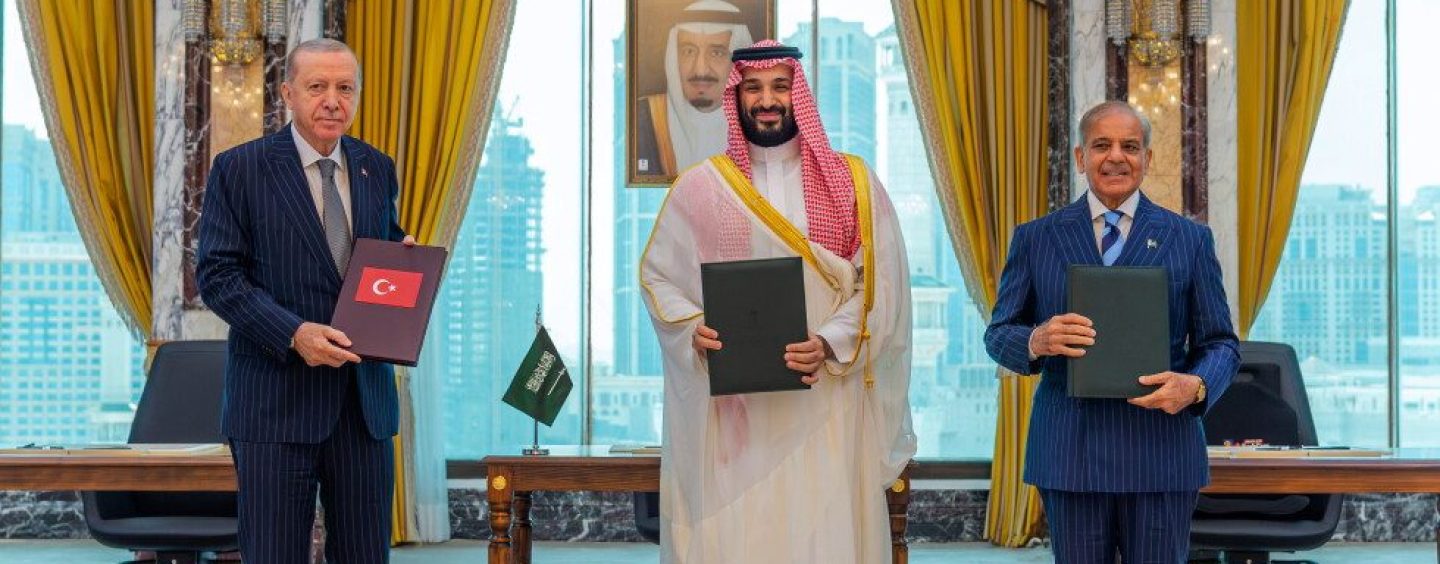
Saudi Crown Prince Mohammed bin Salman and Turkish President Recep Tayyip Erdoğan had already been looking for an arrangement capable of providing a strong regional security guarantee stretching from the Persian Gulf and Arabian Sea to the Red Sea, Mediterranean, and Black Sea. When the two leaders signed the Mecca Defense Pact on August 7 alongside Pakistan’s Prime Minister Muhammad Shehbaz Sharif, a door of possibilities opened—one that could, one day, allow the entire world to breathe a sigh of relief.
Looking at the timeline of these developments, the first step was the defense agreement between Pakistan and Saudi Arabia. In the second phase, Pakistan, Saudi Arabia, and Türkiye signed a trilateral agreement that has been named the Mecca Defense Pact. It is being suggested that Egypt could join the agreement in the third phase, potentially creating a new Quad.
The first Quad established to help safeguard global maritime trade in the Indian Ocean and provide stronger guarantees for regional security consists of the United States, Japan, Australia, and India. Because of India’s shortcomings, this Quad has failed to deliver the results once expected of it. But the journey initiated by the Mecca Defense Pact could lay the foundation for a new dream through the emergence of a potential new Quad. This possibility is strengthened by the fact that the pact has deliberately left the door open for additional countries to join.
There is also speculation in international diplomatic circles that additional countries from East Asia, North Africa, the South Caucasus, Central Asia, and the Middle East could eventually become part of this defense framework. If such an expansion becomes a reality, by 2030 the Mecca Pact may no longer be merely a regional defense agreement. Instead, it could evolve into a broader strategic network centered on the critical maritime routes—and particularly the chokepoints—through which global trade moves between East and West.
Türkiye, Saudi Arabia, and Pakistan are already situated in geographic regions connected, directly or indirectly, to four major maritime chokepoints of global commerce: the Strait of Hormuz, Bab el-Mandeb, the Suez Canal, and the Turkish Straits.
The importance of these four chokepoints to global trade and energy security is well known. With the potential inclusion of additional countries, a network extending from the Strait of Malacca to the Strait of Gibraltar could grow beyond a regional agreement into a force with global strategic influence.
This is a game of possibilities that could reshape world politics. For India, the realization of this vision associated with the Poet of the East could become a nightmare. A network playing a key role in facilitating and providing stronger guarantees for peaceful maritime commerce between East and West—from the Strait of Malacca to the Strait of Gibraltar—could further diminish New Delhi’s global and strategic significance.
Pakistan’s national poet Dr. Allama Muhammad Iqbal said a century ago :
«“What the eye sees cannot always reach the lips;
I am lost in wonder at how the world may transform.”»
The great philosopher known as the Poet of the East expressed another powerful vision:
«“Let Muslims unite to guard the sanctity of the Holy Sanctuary,
From the shores of the Nile to the soil of Kashgar.”»
What a remarkable coincidence that the pact laying a foundational brick toward the practical realization of this vision has itself been named the Mecca Defense Pact, invoking the sanctity of the Holy Sanctuary.
Egypt, Azerbaijan, and Malaysia are three countries that already have multiple bilateral defense agreements with Pakistan, Saudi Arabia, and Türkiye. Egypt’s potential participation in the formation of an Islamic Quad has also been discussed in the international media. Analysts closely following the issue say that the three core countries—Pakistan, Türkiye, and Saudi Arabia—are moving cautiously and deliberately to advance this common framework, because even a minor misunderstanding among the world’s major powers could create obstacles to its development.
The balance of global power is not determined solely by missiles, fighter jets, and nuclear weapons. Sometimes, the real source of power lies in the narrow maritime passages through which the world’s energy, trade, and supply lines flow.
It is in this context that the joint defense agreement signed by Saudi Arabia, Pakistan, and Türkiye in Mecca on August 7, 2026, should be viewed not merely as a military arrangement but as an important signal of a changing regional balance of power. The agreement’s fundamental principle is that an armed attack against any one of the three countries will be considered an attack against all three.
To understand the significance of this agreement, one must look at the map of the world. Although none of the three countries directly controls all four major global maritime chokepoints, their geographic positions form an extraordinary strategic arc around these critical routes: the Strait of Hormuz, Bab el-Mandeb, the Suez Canal, and the Turkish Straits.
In its current form, the Mecca Defense Pact already represents a strategic arc. By 2030, however, if it expands from the Strait of Gibraltar to the Strait of Malacca, it could emerge as a Greater Strategic Arc—one encompassing a broader network of countries and maritime routes.
The potential inclusion of North African countries such as Egypt, Algeria, and Morocco; Central Asian and neighboring states such as Azerbaijan and Turkmenistan; Middle Eastern countries including Oman, Qatar, and Iraq; and East Asian nations such as Bangladesh, Malaysia, and Indonesia could transform this framework into something far greater than a regional defense arrangement.
If such a network takes shape, its role in securing and facilitating global maritime commerce could provide the world with a greater sense of stability—from the Strait of Malacca to the Strait of Gibraltar—and establish the Mecca Defense Pact as a powerful guardian of the sea lanes upon which the global economy depends.