By Farhad Mammadov, for haqqin.az
The recent anniversary of the peace summit involving Azerbaijan, Armenia and the United States, held at the White House last August, together with new statements issued by Washington, Baku and Yerevan in this context, has triggered a fresh wave of debate over the Zangezur Corridor.
As previously reported, on the anniversary of the summit, US President Donald Trump held telephone conversations with the leaders of Azerbaijan and Armenia, while senior officials from the foreign ministries of the three countries discussed a range of issues in Washington, including the implementation of the TRIPP project.
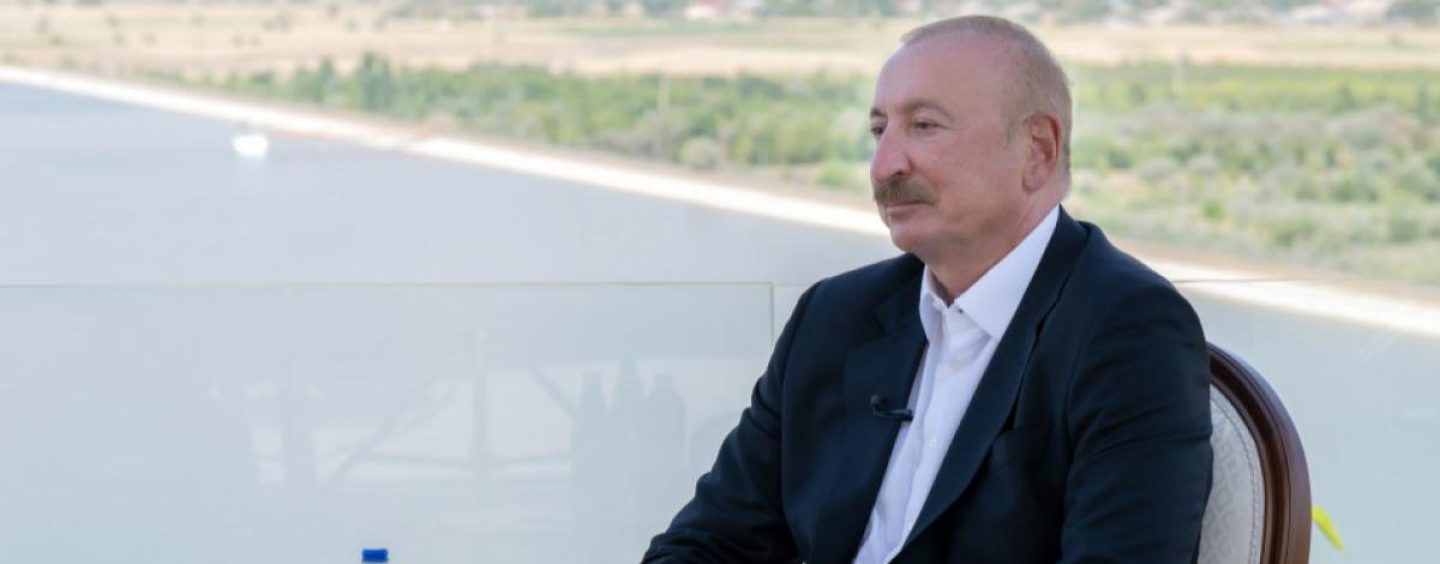
On 11 August, during his visit to the Nakhchivan Autonomous Republic, President Ilham Aliyev gave an interview to Azerbaijan Television, in which he also addressed the Zangezur Corridor. Aliyev noted that “when we put forward the idea and initiative of the Zangezur Corridor, the transport component was primarily meant. But today we view it more broadly. For example, we have a project ready to lay electricity transmission lines from mainland Azerbaijan to Nakhchivan through the territory of Armenia.”
In an interview with Azerbaijan Television, Ilham Aliyev noted that “when we put forward the idea and initiative of the Zangezur Corridor, the transport component was primarily meant. But today we view it more broadly.”
The latest statements and diplomatic steps aimed at implementing the agreements reached at the Washington summit, including the agreement between Armenia and the United States on the TRIPP project, are undoubtedly being closely monitored in Iran.
The reason is that Tehran has strongly opposed the Zangezur Corridor project from the outset. More precisely, Iran has maintained an ambiguous position towards the corridor from the very beginning. On the one hand, officials of the Islamic Republic have stated that they do not oppose the opening of transport links in the region, provided that the principles of territorial integrity and sovereignty are respected. On the other hand, they have suggested that the Zangezur Corridor could “close” Iran’s border with Armenia, thereby restricting its access to the Black Sea.
In addition, conservative circles in Iran have argued that “the corridor serves the idea of Turan” and therefore poses a threat to the Islamic Republic.
Iran subsequently continued to demonstrate an ambivalent attitude towards the agreement on the Zangezur Corridor reached in Washington. On the one hand, the government acknowledged that the TRIPP agreement did not pose a threat to Iran’s national security. On the other, the Islamic Revolutionary Guard Corps (IRGC) and conservative political circles described the proposed 99-year lease of the Armenian section of the corridor to the United States as a threat to Iran.
The years-long confrontation between the United States and Iran later escalated into direct military conflict and continues to this day.
When the United States and Israel launched a war against Iran in February this year, many analysts in the West believed that the conflict could jeopardise the implementation of the TRIPP project. After all, the territory through which the so-called “Trump Route” would pass lies directly along Iran’s border.
Washington, however, has demonstrated that it has no intention of abandoning the TRIPP project despite its military confrontation with Iran and the new geopolitical realities that have emerged in the Middle East. Despite repeated protests and warnings from Tehran, the Trump administration has recently taken a number of concrete steps towards implementing the project.
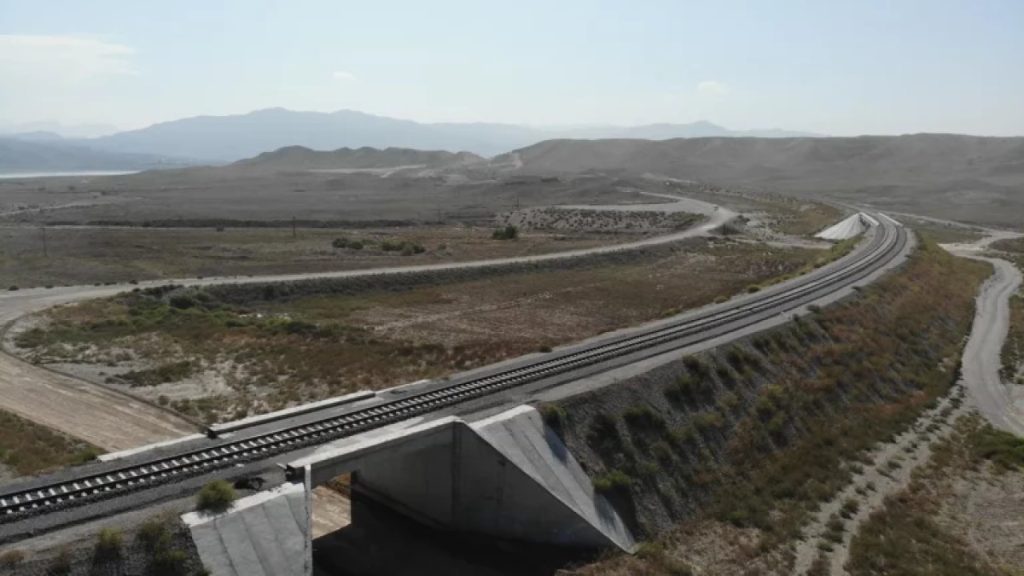
The Zangezur Corridor project has faced strong opposition from Iran from the outset.
Thus, uncertainty over the “Trump Route” persists in Tehran.
Recently, Sarkis Khandanyan, a member of Armenia’s ruling Civil Contract faction, told journalists that Yerevan and Tehran had reached an agreement on the TRIPP project. The statement prompted a sharp reaction from Iranian conservative circles.
IRGC General Yahya Rahim Safavi said that no preliminary agreement on the TRIPP project had been reached between Tehran and Yerevan. The general believes that TRIPP, in its current form, poses a threat to Iran, although negotiations with Armenia are continuing.
“But if responsibility for security there is assigned to the US armed forces, Iran reserves the right to take appropriate measures. It would be better if Armenian border guards themselves controlled the Iranian-Armenian border and the routes passing through it,” Safavi said.
It should be noted that the TRIPP agreement does not contain a provision stipulating that the corridor’s security will be ensured by US military personnel. Consequently, Iran has no formal grounds for taking “retaliatory measures”, as General Safavi put it.
Tehran does not appear to be directly opposed to the route being operated by a joint company in which the United States holds a 74 per cent stake, but says it still has “questions”.
General Yahya Rahim Safavi rejected Armenia’s statements, saying that no preliminary agreement on the TRIPP project had been reached between Tehran and Yerevan.
On 8 July, Iran’s ambassador to Armenia, Khalil Shirgolami, said that Tehran had “legitimate concerns” regarding the TRIPP project. The diplomat said that Tehran wanted Yerevan to provide clarification on these concerns. The ambassador stressed that risk management and the resolution of problems arising from the possible implementation of the project should be placed on the agenda of Armenian-Iranian relations.
An analysis of statements by General Safavi, Ambassador Shirgolami and other Iranian officials therefore indicates that Tehran continues to maintain an ambiguous position towards the TRIPP project.
An editorial published by the Fars news agency, which is close to the IRGC, addresses the issue and argues that Tehran should clarify its position in the near future. The article also examines in detail recent statements by the Azerbaijani president regarding the Zangezur Corridor.
“These statements indicate that Baku views Zangezur not merely as a transport route. Connecting railway and road networks with energy and communications infrastructure could transform this route into a multi-purpose axis which, once completed, would strengthen Azerbaijan’s position within the regional communications network running east–west and north–south,” Fars writes.
Iranian Ambassador to Armenia Khalil Shirgolami says Tehran has “legitimate concerns” regarding the TRIPP project.
Noting that issues related to the implementation of the TRIPP project were also discussed during the telephone conversation between Aliyev and Pashinyan, the agency says that recent developments surrounding the Zangezur Corridor have gradually moved beyond the framework of bilateral dialogue between Baku and Yerevan and acquired a broader regional dimension.
“Since any change to the routes of the South Caucasus directly affects the interests of Russia, Türkiye, Iran and even transnational actors,” the article notes.
Fars recalls that Russia is clearly interested in the opening of all transport routes in the region, as Moscow has an interest in expanding trade links with southern markets and developing new transit routes.
“However, the development of the Zangezur Corridor project may have various implications for Iran. On the one hand, Tehran views the development of transit infrastructure and the expansion of regional transport connectivity as an opportunity for trade and transit. On the other hand, it is sensitive to any changes to international borders or the creation of a mechanism that could affect Iran’s access to Armenia.
“The significance of this issue for Iran increases when the situation in Zangezur is viewed in the context of Azerbaijan’s efforts to expand its role in the East–West and North–South corridors. Under such circumstances, the new route could not only facilitate the transportation of goods and passengers, but also influence the geopolitical weight of countries and transit routes.
“From this perspective, the main issue for Tehran is not simply the construction of a road or railway on Armenian territory. The key question is the legal status, management arrangements and implications of the route for Iran’s overland connection with the Caucasus. The further the project advances, the more important it will become for Iran to determine these aspects,” Fars writes.
Zangezur is becoming a “blind spot” for Iran in the Caucasus; the problem cannot be resolved through short-term political measures alone, Fars writes.
As the article notes, at a time when Azerbaijan is discussing a capacity of 15 million tonnes for the Zangezur Corridor, while the development of the route is simultaneously being proposed alongside energy and communications networks, delays in resolving its geopolitical aspects could impose significant costs on Iran.
“For this reason, Zangezur is becoming a ‘blind spot’ for Iran in the Caucasus. This problem cannot be resolved through short-term political measures alone and requires a clear strategy regarding transit, borders, relations with Armenia and Azerbaijan, as well as Iran’s place within the network of regional corridors.
“Tehran must clarify its position on the continuation of this process, and this knot must be untied as soon as possible, before new routes emerge in the region. Otherwise, Iran will be forced to confront a reality in which it will no longer play a decisive role in shaping it,” the Iranian agency warns.