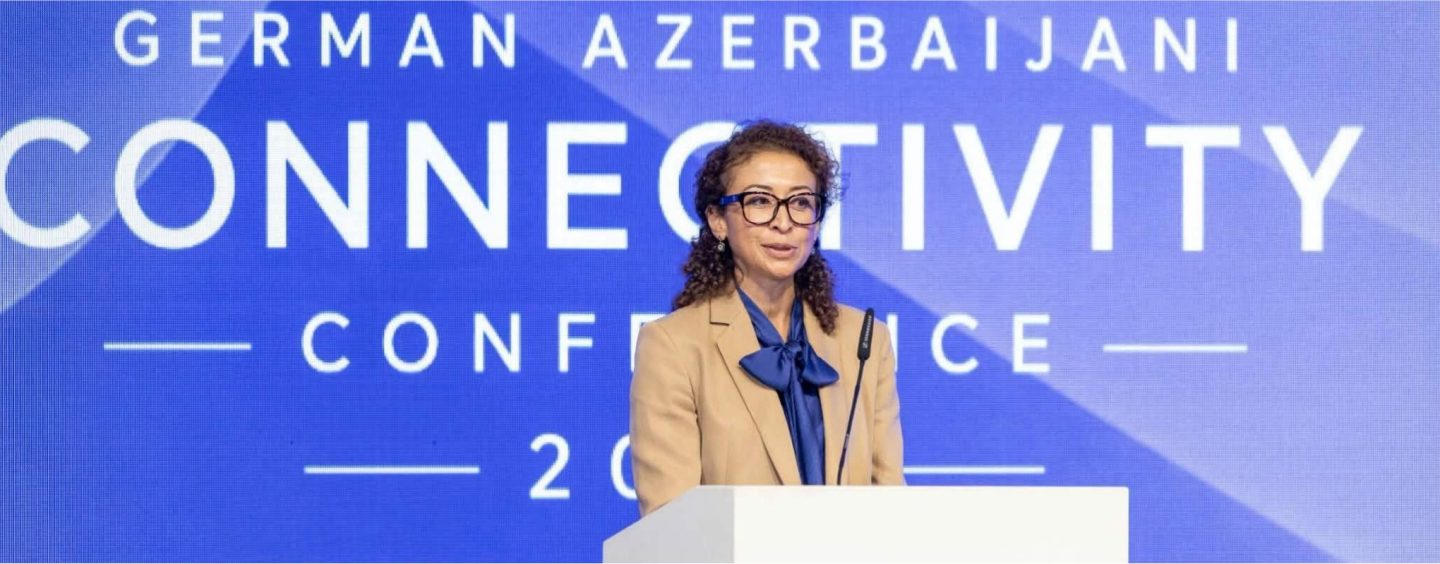
An interview with Ms. Nargis Wieck, Executive Director of AHK Azerbaijan for Azerbaijan Today magazine
Questions prepared by Rovshan Pashazadeh.
A.T.: How would you assess the current level of economic and trade relations between Germany and Azerbaijan?
N. W.: I see a well-established trading relationship that is ready for deeper business cooperation. Germany is already a supplier of machinery and industrial technology, while Azerbaijan is an important energy partner. The Strategic Agenda signed in July gives this relationship additional direction. The next step is to involve German companies more closely in Azerbaijan’s production and infrastructure projects and help Azerbaijani businesses enter European supply chains. Greater transparency and fair competition would strengthen investor confidence and support this transition.
A.T.: More than 200 German companies are currently operating in Azerbaijan. What are the main projects these companies are involved in, and how would you assess their contribution to the Azerbaijani economy?
N. W.: German business engagement extends beyond energy into manufacturing and transport infrastructure. Alongside Siemens equipment for Baku Metro and SOCAR–Uniper’s industrial energy project in Sumgayit, German suppliers provide technology for food processing and beverage production. For example, ENNA’s beverage plant in Nakhchivan uses Krones machinery. AzVirt, founded as a German-Azerbaijani joint venture, contributes through road and airport construction and its longstanding cooperation with German equipment suppliers. These activities bring practical benefits to Azerbaijan: more efficient production, improved product quality and stronger transport connections, supported by German technology and technical expertise.
A.T.: Bilateral trade between Azerbaijan and Germany amounted to approximately €1.7 billion in 2024. What level does the AHK aim to reach in the coming years, and which sectors do you see as having the greatest potential to drive further growth?
N. W.: Our priority is to help more companies establish lasting commercial relationships, rather than put forward a numerical trade forecast. AHK Azerbaijan supports this through market advice, business partner searches and sector-specific delegations. Upcoming visits focus on food-processing and packaging machinery in October, railway technology in Bavaria in November, and energy infrastructure, storage and e-mobility in December. These programmes connect companies around specific business needs—from upgrading production and rail systems to exploring energy solutions—creating opportunities for German suppliers and supporting Azerbaijan’s economic modernisation.
A.T.: Germany’s launch of natural gas imports from Azerbaijan in 2026 has opened a new chapter in energy cooperation between the two countries. Beyond the gas sector, what specific opportunities are German companies exploring in Azerbaijan’s renewable energy and energy-efficiency sectors?
N. W.: Azerbaijan’s expansion of renewable energy creates significant opportunities for German companies, extending beyond the supply of solar panels and batteries. We see strong potential in grid integration, decentralised energy solutions, industrial decarbonisation and energy efficiency in buildings.
The German Pavilion at Baku Energy Week 2026 demonstrated this range of expertise. Alongside KAESER Kompressoren’s energy-efficient compressed-air systems and NEUMAN & ESSER’s compression technologies, BAE Batterien presented batteries for stationary and renewable-energy applications. AUMA brought expertise in electric actuators and controls, while Pepperl+Fuchs offered industrial automation technologies. These capabilities can support more reliable and efficient energy and industrial systems.
AHK Azerbaijan is building on these exchanges through bilateral dialogue and the upcoming December energy trade mission, connecting German technology providers with Azerbaijani partners. Our focus is on practical solutions and commercially viable projects.
A.T.: The AHK’s Human Resources and Vocational Education Working Group in Azerbaijan is working to promote the application of German expertise in this field. What specific steps are being taken to expand the application of Germany’s dual vocational education and training model in Azerbaijan?
N. W.: AHK Azerbaijan brings employers, training institutions and German experts together to connect vocational education more closely with business needs. Our April 2026 workshop with BiWE provided a practical setting for this exchange. Alongside AHK’s activities, BiWE’s partnership with three Azerbaijani vocational centres supports employer-oriented training and the development of trainers. Our contribution is to bring the business perspective into this dialogue, helping ensure that the skills being taught are relevant to the workplaces where graduates will use them.
A.T.: On 21 July 2026, an agreement was reached to establish the German-Azerbaijani Business Council. What new practical opportunities do you believe this mechanism will create for companies from Azerbaijan and Germany?
N. W.: Our ambition is not to create yet another dialogue format, but to establish a structured, results-oriented dialogue between business and policymakers. A key element will be the development of a joint project pipeline, enabling German and Azerbaijani companies to identify, develop and implement concrete projects. The Business Council will provide a platform to address obstacles and secure the necessary political support for their implementation. We see particular potential in connectivity, transport and logistics, renewable energy, digitalisation and industrial cooperation. Ultimately, the Council’s success will be measured by tangible projects, investments and long-term business partnerships.