
Interview with Ms Mehriban Alakbarzadeh, Artistic Director of AzTV CJSC, Laureate of the State Prize of the Republic of Azerbaijan and Honoured Art Worker of Azerbaijan, for Azerbaijan Today Magazine.
Questions prepared by Rovshan Pashazadeh.
A.T.: Hüseyn Javid, often referred to as the Shakespeare of the East, explores the struggle between good and evil, a theme that has remained relevant for more than a century. What inspired you to revisit this classic work and create The Devil and…? What message do you wish to convey to contemporary audiences?
M.A.: The conflict you have mentioned lies at the heart of The Devil, which was written against the backdrop of the First World War. The play reflects the devastating consequences of war, portrays the forces of evil as devilish in nature, and calls upon humanity to rise above its imperfections and become more virtuous than the Devil himself.
Considered Hüseyn Javid’s first poetic drama, the work presents the Devil as an embodiment of forces capable of engulfing all humanity. In my interpretation, however, the Devil is not merely a target to be confronted; he is also a spreading danger. I emphasise that this danger is growing and that the number of his successors is increasing.
Nearly a century later, despite changes in its outward form, this threat remains very much alive. Yet what interested me most was not the events themselves, but the underlying dynamics of the conflict: the eternal triangle of God, the Devil and Man.
The conflict between the Devil and God has been explored extensively in both Eastern and Western thought. My own interpretation places particular emphasis on the ideal of the perfect human being—a model that is now beginning to disintegrate. For this reason, a degree of deconstruction was essential to my staging.
The production is entitled The Devil and…, and its genre is philosophical-deconstructive metadrama.
In essence, the Devil enters into conflict with God over the special attention God bestows upon humanity and the value He places on human beings. Seeking to prove that humanity is inherently flawed, the Devil resorts to every possible means to demonstrate this until the Day of Judgement.
Through this stage of the conflict, I highlight how human beings have forgotten their mission to become perfect beings. This poses a profound danger, and it is precisely the time in which we are living today. The Devil is everywhere—even among us.
A.T.: The ellipsis in the title, The Devil and…, is intriguing. What does it signify? Is the audience expected to complete the phrase for themselves?
M.A.: Yes, you are absolutely right. After watching the performance, the audience should arrive at their own conclusions: The Devil and Man, The Devil and God, or The Devil and His Successors.
This is precisely what I intended to achieve as the director and the author of the reconstruction.
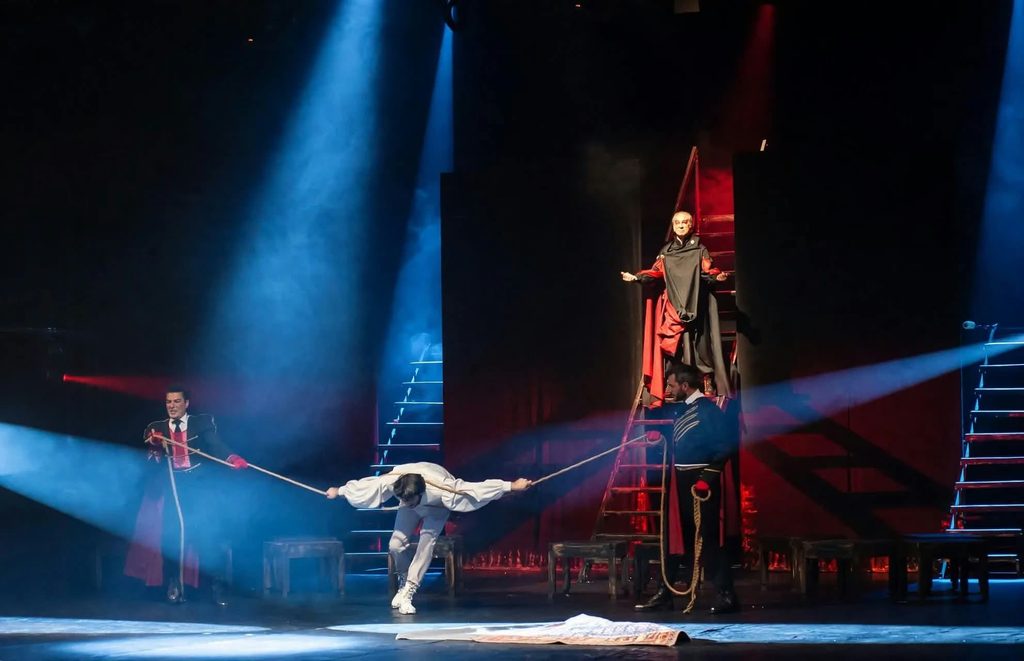
A scene from the play “Iblis” (The Devil)
A.T.: In your interpretation, is the Devil an independent force of evil, or is he the embodiment of the darkness within human beings?
M.A.: The Devil is an independent—an exceptionally independent—force. He is also profoundly ambitious and destructive. He longs to return to God, yet remains a power that is entirely free, independent and answerable to no one. Nevertheless, he needs God’s love.
Human beings, meanwhile, are God’s most beautiful, most beloved and most powerful creations, but they are not necessarily the wisest. They do not always live up to God’s desire for them to become perfect beings. The voids within them grow from time to time, while their desires and appetites consume them from within.
In this sense, the Devil is perfect.
A.T.: In today’s world, marked by wars, political confrontations and humanitarian crises, what truths does Javid’s work remind humanity of? Why do human beings continue to experience the same tragedies throughout history?
M.A.: Hüseyn Javid aspired to the ideal of the perfect human being. He embodied this ideal in the character of Arif—a knowledgeable, informed, enlightened and spiritually awakened individual, a person possessing irfan, or inner wisdom.
In classical Eastern literature and Sufism, the concept of irfan refers to spiritual knowledge and wisdom, traditionally associated with the mystic.
Javid’s vision of the human being, embodied by Arif, remains within the realm of utopian thought: a person who is fully aware and conscious of all things. The higher aspirations and ideals expressed in Javid’s dramaturgy are undoubtedly utopian, yet they represent an outcome that humanity must strive towards.
The fundamental question is this: can an ideal human being create an ideal society?

A scene from the play “Iblis” (The Devil)
A.T.: Is responsibility for the spread of evil borne solely by those who perpetrate it, or does a society that remains silent in the face of injustice share that responsibility? How does your production address this question?
M.A.: Humanity is responsible for the spread of evil. The very purpose of human existence, from the moment of creation until the end, is to strive towards becoming a perfect human being. The transformation of human beings into their ideal form is the fundamental purpose of the human model created on Earth.
If we accept the idea that only the spirit of a perfect human being can return to God, we must examine the world around us. Today, people bargain away values such as conscience, truth, justice, humanism, love and compassion. They reject these values and adopt an entirely antagonistic stance, living in opposition to them.
When confronted with the ultimate catastrophe, however, they fail to recognise themselves in the mirror. Unable to see evil reflected in the horrors of this world, they fail to understand that evil is among us.
A.T.: What new ideas could Hüseyn Javid’s philosophical legacy contribute to world theatre? What opportunities should be explored to bring Azerbaijani dramaturgy to a wider international audience?
M.A.: Let us pause here, because this subject deserves particular attention.
The world needs these intellectual lights—not merely Azerbaijan, but humanity as a whole. For this reason, I believe that Hüseyn Javid’s international recognition is essential.
Javid is a distinctive and original playwright whose work offers a singular and creative perspective within world dramaturgy. We premiered this production in St Petersburg, where the Imperial Theatre showed particular interest in the work.
Yet we are often late in introducing our literary and theatrical heritage to the world. We do not always manage to capture international interest, nor do we make the sustained efforts required to promote our cultural legacy. As a result, our writers remain insufficiently recognised internationally.
In my view, the world should not remain unfamiliar with a playwright of Javid’s calibre and philosophical depth. His works belong not to a single nation, but to eternity.
Hüseyn Javid’s dramaturgy is distinguished by its philosophical and cosmic vision. Through the language of theatre, it explores humanity’s place in the universe, the nature of existence, and the concepts of time and space. This approach moves beyond ordinary, everyday concerns to seek answers to more universal and fundamental questions.
His works must be brought to international stages more widely and promoted with greater determination.
A.T.: Ms. Mehriban, if you were invited to direct a production in a Western country, which playwright’s work would you choose, and what idea would underpin your choice?
M.A.: As an Azerbaijani citizen, my answer would unequivocally be Hüseyn Javid. However, if we consider the matter from the perspective of my professional practice as a theatre director, my answer would be Shakespeare—Shakespeare!
The eternal and fundamental conflicts underlying all drama, both written and yet to be written, are present throughout his work.
I would not wish to limit this choice to a single play. Nevertheless, Hamlet and Othello hold a particular fascination for me. It would be especially interesting to explore Shakespeare through the perspective of an Eastern sensibility—to consider how an Eastern mind interprets his work.
The message is clear: teaching people what it means to be human.
I would not be mistaken in saying that Shakespeare spoke to God while addressing humanity. At least, that is how his work appears to me.